


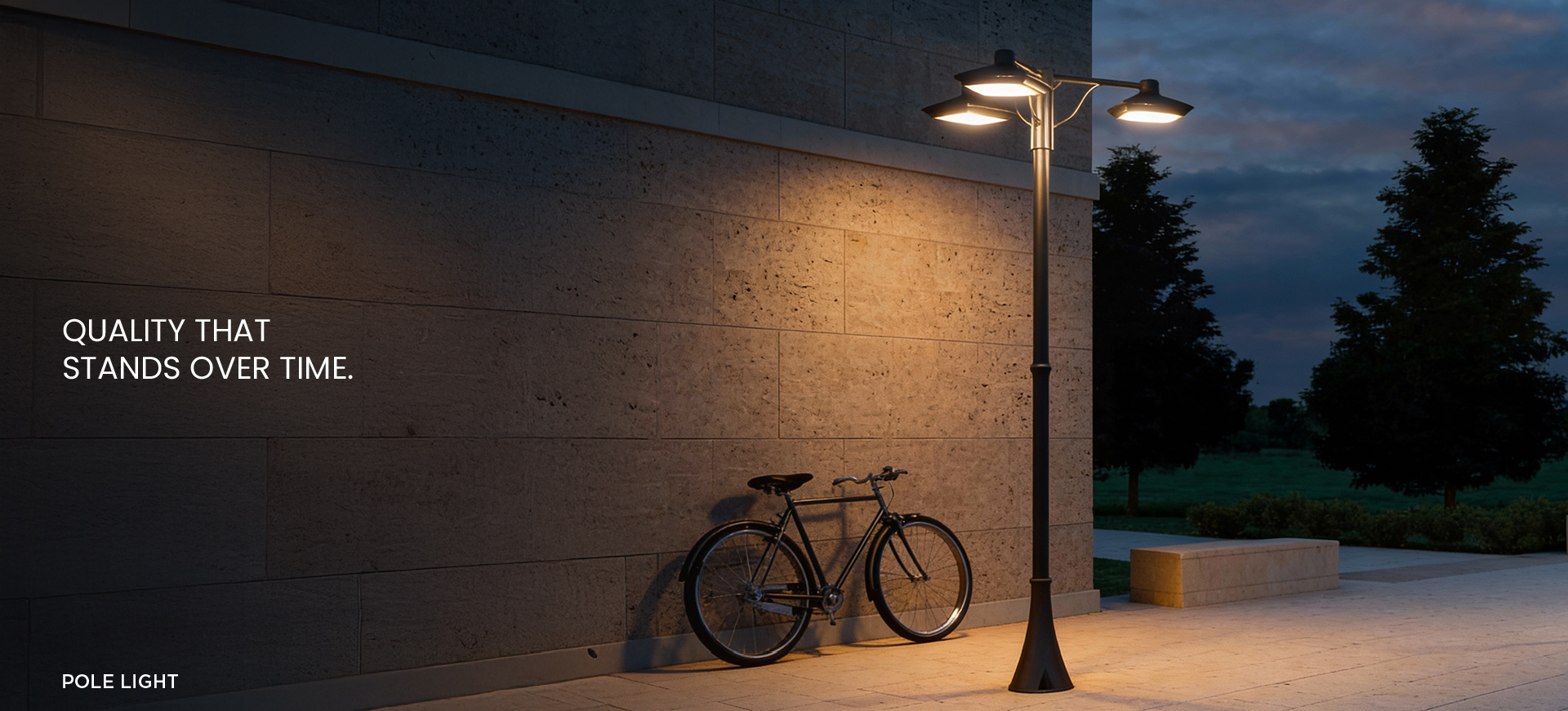
In contemporary outdoor environments, lighting plays a defining architectural role, shaping perception, enhancing safety, and reinforcing a space's identity. From urban streets and public plazas to commercial campuses and landscaped pathways, well-designed lighting infrastructure is essential for both function and aesthetics. This is where thoughtfully engineered designer architectural light solutions come into focus.
At Jaquar, we approach outdoor lighting as an extension of architecture. Our designer poles combine advanced LED technology, durable construction, and refined design language to deliver lighting solutions that perform reliably and enhance the visual character of large outdoor spaces.
The Role of Designer Poles in Architectural Outdoor Lighting
A light pole is often the most visible lighting element in an outdoor environment. Unlike concealed or wall-mounted fixtures, pole lights stand tall and interact directly with their surroundings. This makes them critical for both providing illumination and defining a space's scale, rhythm, and spatial flow.
Our architectural pole lighting is designed to deliver uniform illumination across large areas, including roads, parking zones, campuses, parks, and commercial developments. At the same time, it must withstand harsh environmental conditions and operate efficiently for extended periods. A well-designed decorative lighting pole balances these technical requirements with visual elegance, ensuring the fixture enhances the overall landscape.
Why Designer Poles are Essential for Large Outdoor Spaces
We engineer our designer light poles to play a critical role in defining how large outdoor spaces function, perform, and visually connect with their surroundings. Here’s what makes them an essential element in modern architectural lighting design:
Safety and Visibility at Scale
Large outdoor areas require consistent and well-controlled illumination to ensure pedestrian and vehicular safety. Properly designed pole lights reduce dark spots, minimise glare, and improve visual clarity across wide zones. This is especially beneficial in public spaces, parking areas, and urban infrastructure, where adequate lighting helps prevent accidents and enhances overall security.
Structural Durability and Weather Resistance
Outdoor lighting fixtures are exposed to rain, dust, heat, humidity, and pollution. Our designer poles are made using robust materials such as die-cast aluminium and corrosion-resistant finishes. High ingress protection ratings (typically IP65 or higher) protect internal components against dust and water, ensuring reliable performance with minimal maintenance over time.
Energy Efficiency Through Advanced LED Technology
Modern architectural lighting relies heavily on LEDs for their efficiency and longevity. Our designer architectural light solutions use high-efficacy LED modules that deliver higher lumen output per watt, significantly reducing energy consumption compared to conventional lighting systems. This reduces operational costs and supports sustainable lighting practices across large installations.
Design Versatility and Architectural Harmony
A lighting fixture should complement its surroundings, not overpower them. We offer a wide range of pole designs that suit contemporary urban settings as well as more traditional spaces. Clean lines, balanced proportions, and refined finishes ensure that each architectural light integrates seamlessly into its environment while maintaining a strong visual presence.
Technical Flexibility for Diverse Applications
One of the key strengths of modern pole lighting lies in its adaptability. Designer poles can be customised to suit different project requirements through a range of technical parameters:
- Wattage options typically ranging from 25W to over 200W, depending on mounting height and area coverage
- Colour temperatures from warm white (3000K) to neutral and cool white (4000K-5700K), allowing designers to control mood and visibility
- Optical configurations such as narrow, medium, or wide beam angles to ensure precise light distribution
- Mounting heights tailored to pedestrian pathways, landscape zones, or roadways
This level of flexibility ensures that each light pole delivers optimal performance without excessive brightness or energy waste.
Smart Integration and Control Systems
As cities and commercial spaces move towards intelligent infrastructure, lighting systems are evolving too. Many Jaquar pole lights are compatible with smart lighting controls, including motion sensors, daylight sensors, and programmable timers. These systems allow automated operation, adaptive lighting levels, and remote monitoring, improving efficiency while reducing unnecessary energy usage.
Such intelligent features make our designer poles suitable for future-ready developments where sustainability and operational control are key priorities.
Thalia Bollard and Kujo Pole Lights: Design Meets Recognition
At Jaquar, our commitment to excellence in architectural lighting is reflected in globally recognised designs like the Thalia bollard and Kujo pole lights, both designed by renowned designers Claudia Danelon and Federico Meroni.
Thalia - Bollard
The Thalia bollard is designed to deliver subtle, low-level illumination for pathways, gardens, and landscape zones. Its controlled light output enhances visibility without glare, making it ideal for pedestrian-friendly environments. The design focuses on clean geometry and balanced proportions, ensuring the bollard integrates naturally into landscaped settings.
Kujo- Pole Light
The Kujo pole light represents a bold yet refined approach to outdoor architectural lighting. Designed for larger spaces, it delivers powerful, uniform illumination while maintaining visual elegance. Kujo has received international acclaim, including the LIT 2025 Lighting Design Award, recognising exceptional lighting designs from around the world. Additionally, our lighting solutions have been honoured with the German Design Award, celebrating global design excellence with purpose.
These recognitions reinforce our belief that performance and design must go hand in hand.
Choosing the Right Designer Pole Lighting
When selecting architectural pole lighting, it’s important to consider both technical and contextual factors:
- Application type: Roads, pathways, plazas, or landscaped areas all require different lighting levels
- Mounting height and spacing: Determines light spread and uniformity
- Environmental conditions: Coastal or industrial zones may require enhanced corrosion protection
- Visual impact: The fixture should align with the architectural language of the space
- Energy and maintenance considerations: Efficient LEDs and durable materials reduce long-term costs
A well-planned lighting layout ensures that pole lights contribute to both functionality and aesthetics.
Why Choose Jaquar for Architectural Pole Lighting
At Jaquar, we design lighting systems that do more than illuminate. Our architectural lighting solutions are built on a foundation of engineering precision, material durability, and thoughtful design. From decorative lighting pole solutions to high-performance pole lights for large-scale applications, we offer products that deliver consistent output, long life, and visual harmony.
With globally awarded designs like Thalia and Kujo, we continue to push the boundaries of what outdoor architectural lighting can achieve, combining innovation, sustainability, and design excellence.FAQs
Designer poles focus on architectural integration, refined aesthetics, and advanced optical performance, while standard poles prioritise basic illumination.
Yes. Pole lights can be used across residential campuses, commercial complexes, public spaces, and urban infrastructure.
LED pole lights offer high lumen efficacy, a long lifespan, and significantly lower power consumption than traditional lighting.
High-quality designer poles are built with weather-resistant materials and high IP ratings, ensuring durability in demanding environments.
Kujo combines powerful illumination with award-winning design, recognised globally for excellence in architectural lighting.
Yes, many of our solutions are compatible with sensors and smart control systems for efficient and adaptive lighting.
 Bath :