


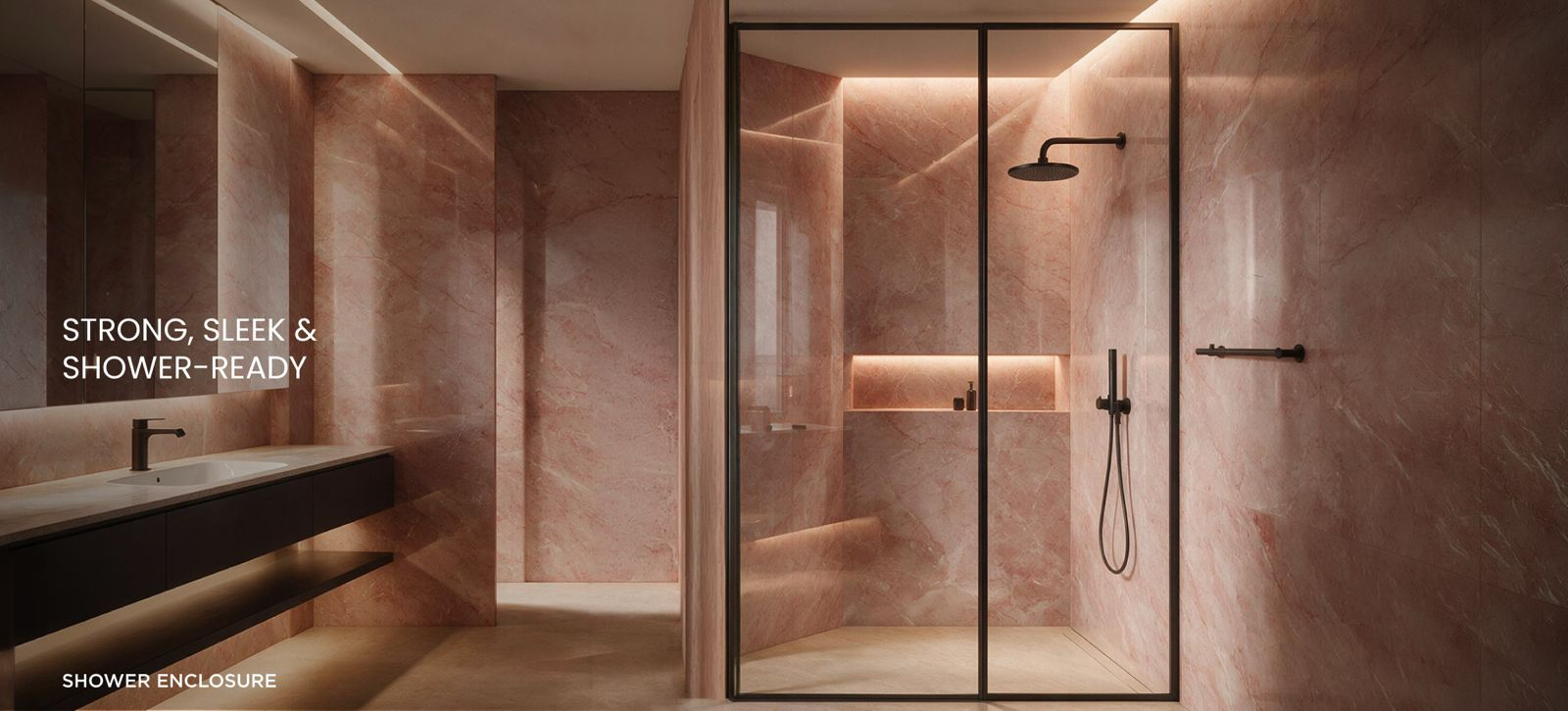
Toughened glass is processed to offer greater strength and safer breakage behaviour than ordinary glass. It undergoes a special heating and cooling process that makes it stronger to prevent breakage and in the rare event of breakage, glass toughening causes it to break into smaller fragments, making it a safer choice for applications such as shower doors and enclosures.
Glass is a familiar material in modern bathrooms, particularly in shower areas where it helps create an open, spacious and contemporary look. But not all glass performs in the same way. The difference becomes particularly important when choosing glass for an area where it will be exposed to regular impact, movement, moisture and changes in temperature.
For applications such as shower enclosures, understanding the difference between ordinary and toughened glass can help you make a safer and more informed choice. So, what actually makes toughened glass different? For the same, it is important to understand the glass types first.
What Is Ordinary Glass?
Ordinary glass, often referred to as annealed glass, is the standard form of glass produced without any treatment. It is commonly used for applications such as windows, picture frames and decorative elements where additional safety strength may not be necessary.
However, ordinary glass is relatively brittle. When subjected to significant impact or stress, it can break into larger, sharp-edged shards. This makes it less suitable for applications where people come into frequent contact with the glass.
What Is Toughened Glass?
Toughened glass is a type of safety glass that has undergone a controlled heating at around 690 degrees C and rapid cooling process.
This process strengthens the glass, making it more resistant to impact and thermal stress than ordinary glass. Toughened glass is often identified as a safety glazing material used in architectural applications.
One of its most important characteristics is how it behaves when it eventually breaks. Instead of forming large, sharp shards, toughened glass fragments into many smaller pieces. This reduces the likelihood of serious cuts and piercing injuries.
Toughened Glass vs Ordinary Glass: Key Differences
Let us take a closer look at how both these types of glass differ:
| Feature | Toughened Glass | Ordinary Glass |
| Strength | Higher resistance to impact and thermal stress | More susceptible to breakage |
| Breakage |
Hard to break, but if at all breaks, breaks into small fragments | Can form large, sharp shards |
| Safety |
Better suited to safety-critical applications | Less suitable for high-contact areas |
| Heat resistance |
Greater thermal resistance | Lower thermal resistance |
| Processing |
Must be cut and finished before toughening | Can generally be cut or modified after manufacture |
| Common applications |
Doors, partitions, shower areas and other high-contact spaces | Windows, picture frames and decorative applications |
The difference is particularly relevant for bathroom glazing. For showers, bathtub enclosures and doors, toughened glass is ideal and necessary.
Why Is Toughened Glass Better for Shower Enclosures?
Bathrooms present a unique environment for glass. A shower door can be opened and closed repeatedly, exposed to changes in temperature and water, and accidentally knocked during everyday use.
This is why shower enclosures are generally better suited to safety glass than ordinary glass.
Greater Strength
Toughened glass is significantly more resistant to impact and thermal stress than ordinary glass. This makes it better equipped to withstand the demands of everyday bathroom use.
Safer Breakage Behaviour
Toughened glass is impact tested and designed to withstand significant impact during everyday use. However, if it does break due to an exceptional impact or other unforeseen circumstances, it is designed to break into smaller, less sharp fragments rather than large, jagged shards.
Better Suitability for Modern Bathroom Designs
Toughened glass allows bathrooms to incorporate large, transparent panels without making the space feel enclosed. This works particularly well in modern spaces where clean lines and visual openness are important.
How Does Toughened Glass Handle Heat?
Another important difference is thermal resistance.
Bathrooms can expose glass to changes in temperature, particularly when hot water and steam are involved. Toughened glass has greater thermal strength than ordinary glass because of the stresses introduced during the toughening process.
This does not mean that toughened glass is immune to thermal shock or damage. Correct glass specification, installation, and hardware remain important.
What Are the Different Types of Glass Shower Doors?
Once you have chosen safety glass, the next consideration is the design of your enclosure. The types of glass shower doors available can be broadly selected according to the bathroom's layout and available space.
Wall-to-Wall Shower Doors
These are designed to cover the full width of the shower area, creating a clean and seamless look. They can work particularly well when the shower occupies an entire section between two walls.
Walkthrough Shower Enclosures
Walkthrough designs provide an open entry into the shower area without requiring a conventional hinged door. They can create a spacious, minimalist appearance while providing a defined shower zone.
On-the-Wall Shower Enclosures
These shower enclosures are designed to be installed along only one wall, making them a practical choice for defining the shower area while making efficient use of the available bathroom space.
Corner Shower Enclosures
Corner designs are particularly useful when the shower is positioned where two walls meet. They make efficient use of available floor space and can be a practical option for compact bathrooms.
Choosing between these types of glass shower doors is ultimately less about which style is universally better and more about which configuration suits your bathroom layout, movement space and aesthetic.
Does Toughened Glass Need Special Care?
Toughened glass is relatively easy to maintain, but good care can help preserve its appearance.
You can:
- Clean the glass regularly to prevent soap and mineral deposits from building up.
- Use a soft cloth or suitable glass-cleaning product rather than abrasive materials.
- Avoid striking the edges of the glass, as damage to an edge can compromise the panel.
- Have damaged glass or hardware inspected rather than attempting DIY repairs.
An important point is that toughened glass cannot simply be cut or drilled after it has been toughened. All required cutting, drilling, edging and polishing must generally be completed before the toughening process.
Make a Safer, More Stylish Choice with Jaquar
Choosing the right glass can make a significant difference to the safety, functionality and appearance of your bathroom. While ordinary glass may work well for certain applications, toughened glass offers greater strength and a safer breakage pattern, making it a more suitable choice for many high-contact applications such as shower enclosures.
At Jaquar, we offer shower enclosure solutions designed to complement different bathroom layouts and lifestyles. Our range includes wall-to-wall, walkthrough, on-the-wall and corner shower enclosures, giving you the flexibility to choose a design that works for your space. We bring together thoughtful design and practical functionality to help you create a bathroom that feels open, comfortable and contemporary.
FAQs
Yes. Toughened glass is impact tested and designed to offer greater resistance to impact and thermal stress than ordinary annealed glass. It is built to withstand everyday use and demanding conditions.
While toughened glass is designed to withstand significant impact, no glass should be considered completely immune to breakage. In exceptional circumstances, such as a particularly strong impact or damage to an edge, it may break. If this happens, it is designed to break into smaller, less sharp fragments rather than large, jagged shards.
Yes. Toughened safety glass is widely used for shower doors and enclosures because these are high-contact areas where safer breakage behaviour is important.
Consider the bathroom layout, available space, glass specification, door configuration, hardware and installation requirements. The enclosure should be selected as a complete system rather than based on glass appearance alone.
Common configurations include wall-to-wall, walkthrough, on-the-wall and corner designs. The right option depends on the size and layout of your bathroom, as well as how open or enclosed you want the shower area to feel.
No. Toughened glass cannot normally be cut, drilled or significantly altered after the toughening process. Any required fabrication needs to be completed beforehand, which is why accurate measurements and professional installation are important.
 Bath :